Care and daily life
Dog coat care by coat type: brushing, bathing and trimming
By Casa Trufa · · 8 min read
It depends on the coat. A long or curly coat that never stops growing, like that of the Maltese, Maltipoo or Cockapoo, needs daily brushing and regular trims. A double coat, like the Border Collie’s or the Bernese’s, needs a thorough weekly brushing and is never shaved. A short, dense one, like the Blue Heeler’s, needs only weekly brushing.
What type of coat does my dog have?
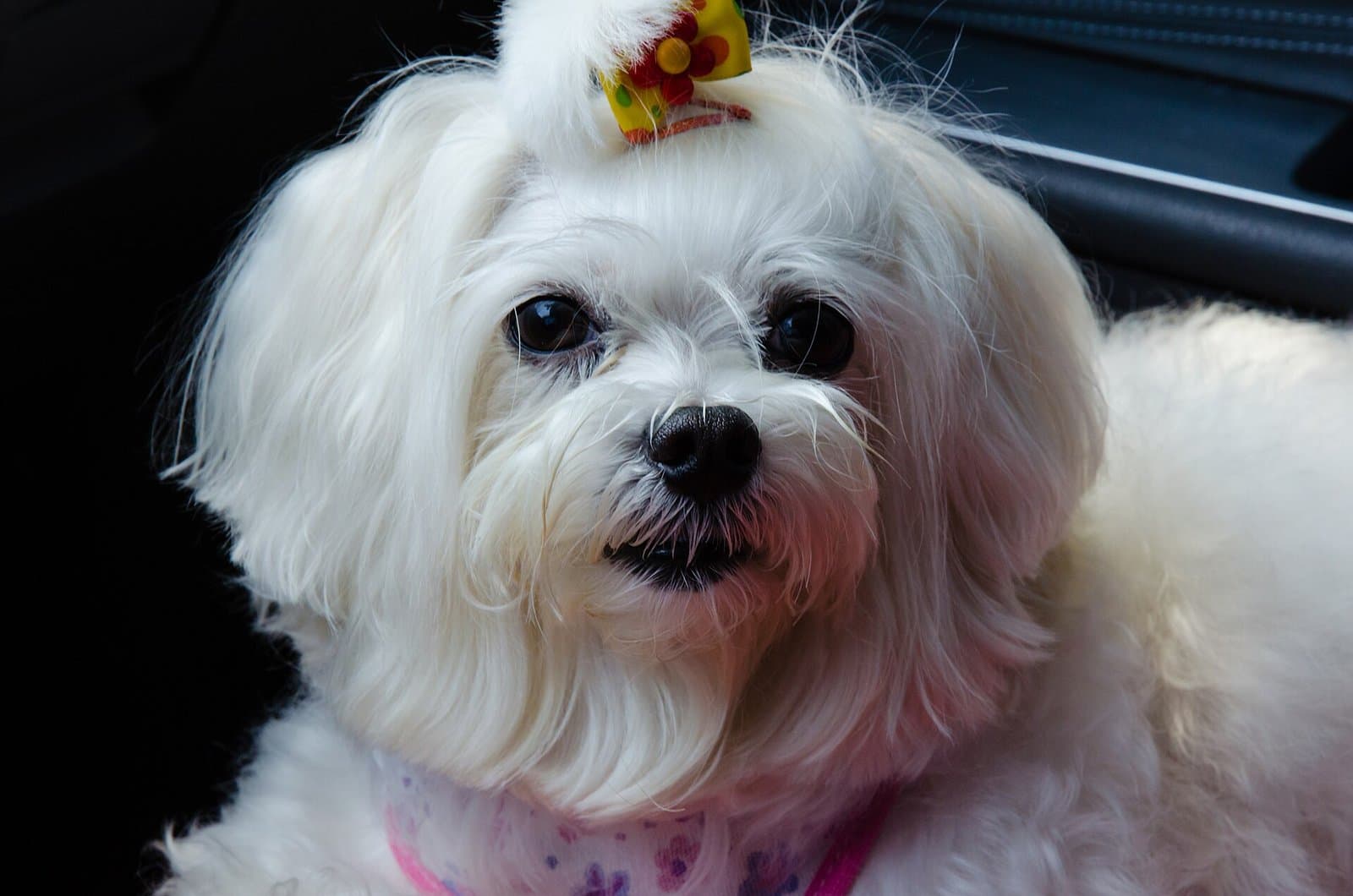
There are two broad families. A single coat has only one type of hair, with no undercoat, and in some breeds it never stops growing. A double coat has two layers: an outer one of longer, tougher hair and an inner one that is short, soft and dense, and insulates. Almost all coat care follows from that difference.
This is how the seven breeds on this site are divided, according to their FCI standards and the American Kennel Club’s classification:
| Breed | Coat type | What it needs most |
|---|---|---|
| Maltese | Single: long, straight and silky, with no undercoat | Daily brushing and trimming |
| Maltipoo | Single, from wavy to curly; it varies because it is a cross | Daily brushing and trimming |
| Cockapoo | From wavy to curly; it varies because it is a cross | Frequent brushing and trimming |
| Cavalier King Charles Spaniel | Long and silky, with feathering on the ears, chest, legs and tail | Frequent brushing, especially the feathering |
| Border Collie | Double, moderately long or short | Thorough weekly brushing |
| Bernese Mountain Dog | Double and long | Thorough weekly brushing, more during shedding season |
| Australian Cattle Dog (Blue Heeler) | Double, short and dense | Weekly brushing |
The Maltipoo and the Cockapoo have no standard, and two littermates can have different coats. How much they shed, and why, is covered in the guide to dogs that don’t shed.
To find out what your dog has, part the hair with your fingers until you can see the skin. If there is a short, woolly layer under the long hair, it is a double coat.
How often should you brush a dog?
It depends on the length and on whether the hair tangles. The ASPCA suggests weekly brushing for short-haired dogs and daily attention for long-haired ones, which mat easily. For double coats, the American Kennel Club speaks of a weekly brushing that removes the loose undercoat.
By coat type:
- Long and silky, or curly (Maltese, Maltipoo, Cockapoo): daily. First a slicker brush to work out tangles, then a bristle brush.
- Silky with feathering (Cavalier): several times a week, taking care behind the ears, in the armpits and on the “trousers”, where mats form.
- Double (Border Collie, Bernese): once a week down to the skin, not just over the top. During shedding season, more often.
- Short and dense (Blue Heeler): once a week is enough to remove dead hair.
Hair that does not fall on the floor does not disappear: in continuously growing coats it stays trapped and forms the mat. That is why the dogs that “don’t shed” are the ones that need the most brushing.
Get the puppy used to it from the start, with short sessions and a reward at the end: it is part of basic puppy training.
How often should you bathe a dog?
The ASPCA recommends a bath at least once every three months, and more often if the dog spends a lot of time outdoors or has skin problems. Long-haired dogs that go to the groomer are usually bathed more often, because the bath is part of the grooming. If in doubt, ask your veterinarian.
The sequence matters more than the frequency:
- Brush before wetting. Dead hair and mats have to come out first.
- Lukewarm water and a dog shampoo.
- Protect the eyes, nose and ears. Do not pour water directly on them; the face is cleaned with a damp cloth. The ASPCA suggests placing a cotton ball in each ear during the bath.
- Rinse thoroughly.
- Dry well, down to the skin in double and curly coats.
How do you remove mats from a dog’s coat?
By working them loose one at a time, without pulling. The ASPCA recommends gently teasing them out with a slicker brush and then going over the coat with a bristle brush. If the mat is very tight, it can be cut out, taking great care not to get close to the skin. With extensive matting, the sensible thing is to go to a groomer.
A mat is not only a cosmetic problem: the ASPCA includes poor coat care among the causes of the red, moist lesions known as “hot spots”.
Hold the hair between the mat and the skin so the tug does not hurt, start at the tip and do not wet the mat before working it out.
Why should you never shave a double-coated dog?
Because it does not cool the dog and can damage the coat. The American Kennel Club explains that the undercoat works as insulation in both directions: in hot weather the dog sheds much of it, and what remains traps air between the two layers and helps the dog regulate its temperature.
Its chief veterinarian, Dr. Jerry Klein, sums it up this way: shaving to reduce shedding or to cool the dog removes that insulating layer and can cause the hair to grow back poorly and damage the follicles. The outer layer also protects the skin from the sun and from insect bites.
There is a lasting effect. When a coat is shaved down to the skin, the undercoat grows back faster than the outer hair and sometimes crowds it out, which changes the texture and color of the coat and leaves it uneven.
And it does not cool: a dog regulates its temperature mainly by panting and by dilating the blood vessels in its ears and face, not through the skin on its back. What does help is a thorough brushing to remove the dead undercoat.
This applies to the Border Collie, the Bernese Mountain Dog and the Australian Cattle Dog. If you live in a hot climate, the coat is not what needs to change: read first about heatstroke in dogs.
Do dogs with continuously growing hair need haircuts?
Yes, in moderation. The American Kennel Club says that certain single-coated dogs benefit from an occasional trim to prevent mats and stay cooler, but without shaving down to the skin: it recommends leaving at least 2.5 cm (1 in) of hair, which protects them from the sun and from insect bites.
Among single coats the AKC names the Maltese and the Poodle, so the guideline extends to the Maltipoo and, to the extent that it has inherited that hair, the Cockapoo. In practice, these are dogs that need regular grooming appointments all their lives, and it is a fixed expense worth adding when you work out how much it costs to keep a dog.
The floor-length coat described in the Maltese standard demands daily commitment; the routine for that breed is in the guide to Maltese grooming and care.
The Cavalier is a different case. Its standard wants it with no trimming at all; in a family dog, the usual approach is to do no more than tidy the feathering that tangles or gets dirty.
How do you care for a dog’s ears and nails?
By looking at them every week, when you brush. Nails are the right length when they almost touch the floor as the dog walks; if they click on the tile or snag, it is time to trim. Healthy ears do not smell: bad odor, redness, discharge or a dog that shakes its head are reasons to see the veterinarian.
On nails, the ASPCA explains that a calm indoor dog may need them trimmed very often, and one that walks on sidewalks every day, far less. There are scissor-type and guillotine-type clippers, and electric grinders; ask the veterinarian or the groomer to show you how to use them the first time, because a cut that goes too high hurts and bleeds.
With ears, less is more. Dry the outside after a bath and do not put cotton swabs or liquids inside unless you have been told to. Breeds with drop ears and a lot of hair, like the Cavalier and the Cockapoo, deserve a more frequent look.
Frequently asked questions
How often should you bathe a dog?
The ASPCA recommends at least once every three months, and more often if the dog spends a lot of time outdoors or has skin problems. A long-haired dog that goes to the groomer is usually bathed more frequently.
Can I shave my Border Collie or my Bernese so it does not get hot?
It is not a good idea. The American Kennel Club explains that a double coat also insulates against heat and protects from the sun, that shaving it does not cool the dog and that the coat may grow back unevenly.
And can a Maltese or a Maltipoo have its coat cut?
Yes. They have continuously growing single coats, and a trim helps prevent mats. The American Kennel Club recommends not shaving down to the skin and leaving at least about 2.5 cm (1 in) of hair.
How do I get a mat out of my dog’s coat?
With patience and a slicker brush, working it loose from the tip toward the skin. If it is very tight, it is cut out, taking great care not to get close to the skin, or left to a groomer.
How often should a dog’s nails be trimmed?
When they almost touch the floor as the dog walks. If you hear them click on the tile or they snag, it is time. A dog that walks little on hard surfaces wears them down less.
Sources
- American Kennel Club: Is it OK to shave your dog?. Double coat and single coat; quotes the AKC’s chief veterinarian
- American Kennel Club: Double-coated dog breeds. Types of double coat and how to brush them; includes the Border Collie and the Bernese Mountain Dog
- ASPCA: Dog grooming tips. Bathing, brushing by coat, mats and nails
- FCI: standard no. 65, Maltese (Spanish text). In Spanish. Dense, silky, very long and straight coat, with no undercoat
- FCI: standard no. 136, Cavalier King Charles Spaniel (English text). Long, silky coat with plenty of feathering
- FCI: standard no. 297, Border Collie (Spanish text). In Spanish. Two coat varieties, both with a soft, dense undercoat
- FCI: standard no. 287, Australian Cattle Dog (Spanish text). In Spanish. Double coat: short, dense undercoat and a smooth, hard outer coat
- FCI: standard no. 45, Bernese Mountain Dog (Spanish text). In Spanish. Long, shiny coat, straight or slightly wavy
Topics coat · coat type · brushing · bathing · grooming
Keep reading
- Genetic tests in dogs: what CEA, TNS, MDR1 and PRA are and how to read the resultHealth tests and pedigree
- Spaying or neutering your dog: when to do it and why the right age depends on sizeHealth
- Farm dogs in Colombia: how to choose by the work, the climate and your routineCare and daily life
- All articles
Related guides and breeds
- Maltese care: coat, tear stains and daily routineGuide
- Small dogs that don’t shed: what’s true and what isn’tGuide
- Do Maltipoos shed? Are they hypoallergenic?Guide
- Maltese: the breed profile
- Maltipoo: the breed profile
- Cavalier King Charles Spaniel: the breed profile
- Cockapoo: the breed profile
- Border Collie: the breed profile
- Australian Cattle Dog (Blue Heeler): the breed profile
- Bernese Mountain Dog: the breed profile
- All guides