
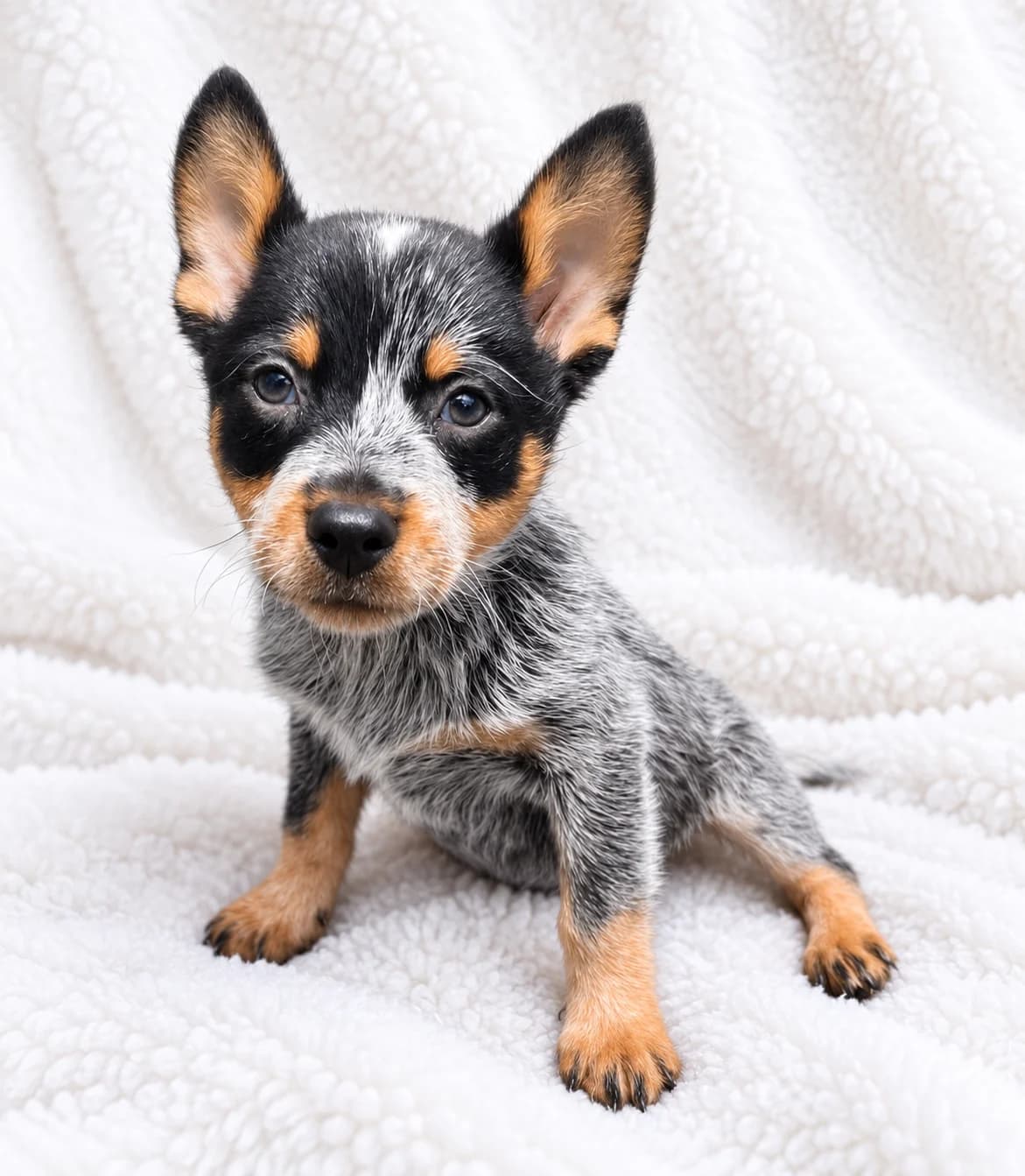
Australian Cattle Dog (Blue Heeler)
Tough, loyal and in need of a job.
Also: Blue Heeler · Pastor ganadero australiano
The Australian Cattle Dog, or Blue Heeler — pastor ganadero australiano in Colombia — is a droving dog of 15–22 kg (33–49 lb), tough, loyal and with very high energy. It suits farms and experienced owners who can give it a job every day. It is not the Australian Shepherd (Aussie), it is not a first dog, and it is not a sofa dog.
The Australian Cattle Dog, or Blue Heeler, is a hard-working dog: tough, faithful and very intelligent. It needs intense activity and a family with experience.
- Adult size
- 43–51 cm (17–20 in) · 15–22 kg (33–49 lb)
- Energy
- Very high
- Temperament
- tough · loyal · independent
- Care
- Medium
- Health
- Tests on the parent dogs: hip dysplasia, PRA (prcd), PLL, hearing test (BAER).
Before you go on
Does it fit your life?
It is for you if…
- You do sports or live in the countryside.
- You have experience with working dogs.
- You can give it a job every day.
It is not for you if…
- It would be your first dog.
- You are looking for a sofa dog.
- There are very small children and little space.
Living with a Australian Cattle Dog (Blue Heeler)
Feeding, health and care, step by step
Eye exams and the BAER hearing test in dogs: what they detect and at what age they are done
A veterinary ophthalmologist does the eye exam, and it is repeated every year; the BAER test measures hearing in each ear and is done once, from 35 days of age. What each one detects and in which breeds it matters.
Farm dogs in Colombia: how to choose by the work, the climate and your routine
No dog is right for every farm: the right one fits your work, your climate and the time you will give it. Herding dogs, the Bernese in the cool highlands, ticks, fencing and when a working dog is a bad idea.
Hip and elbow dysplasia in dogs: what it is, how it is evaluated and what each result means
Dysplasia is evaluated with X-rays, and each body uses its own scale. What grades A to E and 0 to 3 mean, at what age the diagnosis counts, and why healthy parents reduce the risk without removing it.
Our parent dogs’ health tests
Every parent has health tests you can see and verify.
The pages of this breed’s parent dogs, with their tests and documents, are published in Meet the parents.
Climate and life in Colombia
Does your city suit a Blue Heeler?
Of the seven breeds, it tolerates heat the most: it was developed to drive cattle in Australia. It suits the Llanos plains, the Caribbean coast, the Magdalena Medio and the Valle del Cauca, given shade, water and tick control, and it also does well in the cool highlands.
| City | Altitude and climate zone | Blue Heeler |
|---|---|---|
| VillavicencioMeta | ≈ 430 m (1,410 ft)Hot | Suits it wellThe most heat-tolerant of the seven. It asks for shade, water and tick control. |
| MonteríaCórdoba | ≈ 20 m (70 ft)Hot | Suits it wellThe most heat-tolerant of the seven. It asks for shade, water and tick control. |
| ValleduparCesar | ≈ 170 m (560 ft)Hot | Suits it wellThe most heat-tolerant of the seven. It asks for shade, water and tick control. |
| BogotáBogotá D.C. | ≈ 2,550 m (8,370 ft)Cool | Suits it wellIt also does well in the cool highlands. |
Casa Trufa’s general view based on each city’s altitude; it does not replace your veterinarian’s assessment.
Frequently asked questions
What we are asked most about the Blue Heeler.
Are the Blue Heeler and the Australian Cattle Dog the same dog?
Yes. It is the Australian Cattle Dog — pastor ganadero australiano in Spanish; “blue heeler” and “red heeler” describe the coat color, blue or red. It should not be confused with the Australian Shepherd (the Aussie), which is a different breed: hairier, with a different head and a different temperament.
How much does an Australian Cattle Dog cost in Colombia?
MercadoLibre ads and breeders’ websites checked in October 2026 show figures between COP 1,600,000 and COP 6,000,000. Before comparing figures, ask for the parents’ tests: BAER for deafness, PRA-prcd and PLL for the eyes, and hip dysplasia. Casa Trufa tells you the figure on WhatsApp.
Is it classed as a “special handling” or “dangerous” breed in Colombia?
No. It is not on the list of special-handling breeds in Article 126 of Colombia’s Law 1801 of 2016. Even so, it is a working dog that herds by nipping at heels, by instinct: it needs an experienced owner, clear limits and a daily job.
Is it a good dog for a cattle farm in the hot lowlands?
Yes, that is what it was created for. Of our seven breeds it is the one that copes with heat most comfortably. On a farm in the hot lowlands it needs shade, clean water always within reach and rigorous control of ticks and other external parasites.
Can it live in an apartment?
We don’t recommend it. It only works with athletic owners who give it several hours of activity and training every day, and even then it is an uphill life for the dog. If you live in an apartment and want companionship, there are breeds that will be happier with you.
“A dog is not just a pet; it is a companion for life. That is why every decision matters.”
Casa Trufa