
Bringing your puppy home
Your puppy’s first week at home: day by day, and the first night
By Casa Trufa · · 7 min read
For information only: it does not replace a visit to your veterinarian.
The first week comes down to calm and routine: few people, the same food the puppy came with, frequent trips to its toilet spot, plenty of sleep and company at night. Crying on the first nights is normal; vomiting, diarrhea, refusing food or being listless is a reason to call the veterinarian.
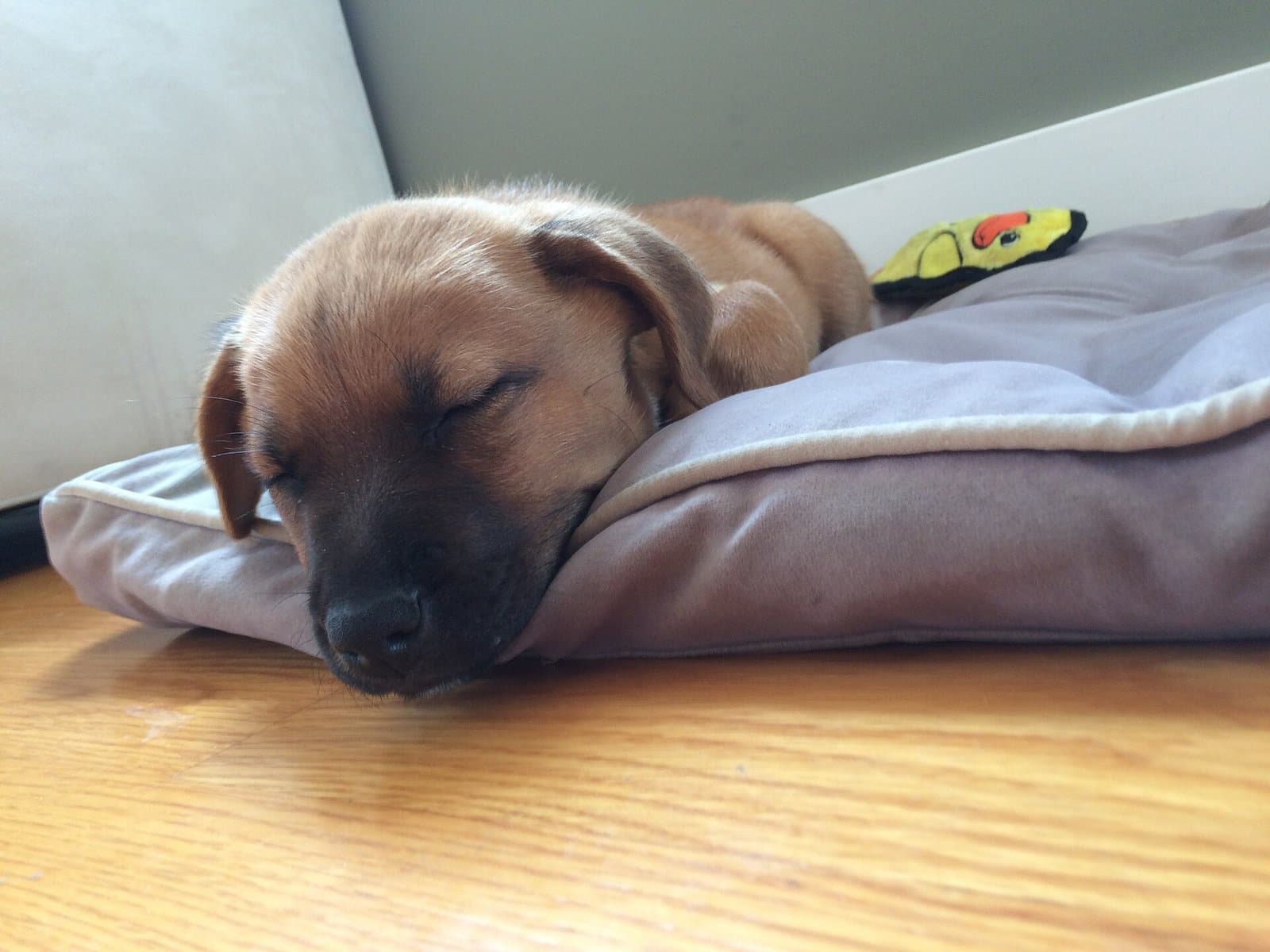
What should you do on a puppy’s first day at home?
Take the puppy first to the spot where you want it to go to the toilet, then introduce the home slowly, one room at a time. Keep things quiet, with few people around, and let it sleep as much as it wants. That is the advice of the British veterinary charity PDSA, which also recommends avoiding visitors for a few days.
The puppy has just left its mother, its littermates and the only place it knew, and has probably come off a journey. There is nothing to teach it that day: it is enough for it to sniff, eat, go to the toilet in the right place and rest.
The ASPCA also recommends not leaving a new dog home alone during the first 48 hours and offering it a refuge in a quiet area from which it can watch the activity from a distance. If you can arrange the arrival for a weekend or a few days off, all the better.
If your home is not ready yet, start with how to prepare your home for a puppy.
Where should the puppy sleep on the first night?
In its bed or crate, but with you in the same room for the first few nights. The PDSA recommends this explicitly: until now the puppy has slept pressed against its mother and littermates, and sleeping near someone helps it adjust. The permanent spot is worth deciding from the start.
What settles a puppy is predictable: one last toilet trip, low light, its bed with a blanket that smells of the litter if the breeder gave you one, and no rough play right beforehand. The same routine every night soon teaches it what comes next.
Expect to get up. At this age a puppy cannot yet hold on all night, so one or two trips out in the small hours are part of the plan, not a bad habit.
What do I do if my puppy cries at night?
Respond calmly. First check whether it needs the toilet; then settle it back in its bed with just enough attention for it to feel it has company, with no play and no fuss. PDSA veterinarians advise against ignoring a puppy: leaving it to cry does not build confidence and can increase its anxiety.
It cries because it is alone for the first time, not to manipulate anyone. Independence is taught little by little: first the puppy sleeps beside you, then a little farther away, then in its permanent spot. How to do this without being left alone turning into a problem is covered in separation anxiety in dogs.
What routine for meals, sleep and toilet trips does a puppy need in the first week?
The same one every day: meals at fixed times with the food it came with, a trip to its toilet spot on waking, after eating, after playing and every two to three hours, short play sessions and a lot of sleep. The amount of food and the number of meals are set by its veterinarian.
| When | What to do |
|---|---|
| On waking | Straight to its spot; a treat and praise when it goes there |
| Meals | The same food and schedule it had at the breeder’s |
| After eating | A trip to its spot 15 to 30 minutes later |
| Play | Short sessions; a puppy tires quickly |
| Naps | In its bed or crate, uninterrupted |
| During the day | A trip out every two to three hours |
| Before bed | A last trip out and a quiet routine |
On food: as a general reference, the ASPCA mentions four meals a day between 8 and 12 weeks and three between three and six months. That is guidance, not a prescription for your puppy. Any change of food is made gradually.
On sleep: the PDSA mentions up to 18 or 20 hours a day. A puppy that does not rest enough is more restless and nips more.
On toilet trips: the timings in the table come from the PDSA and the Merck Veterinary Manual. Accidents are cleaned up thoroughly and without scolding. The full method is in basic puppy training.
Can a puppy go outside in the first week?
Onto the sidewalk, into parks and into areas where many dogs pass, not yet: the prudent thing is to wait until the veterinarian clears it according to its vaccinations. But it can, and should, get to know the world in your arms, in the car and in trusted homes with vaccinated dogs.
The reason for waiting is, above all, parvovirus. According to the Merck Veterinary Manual, it spreads through contact with the feces of infected dogs or with contaminated objects, resists several common disinfectants and can survive for months in a contaminated place. Puppies and unvaccinated dogs are the most exposed.
Waiting does not mean shutting the puppy in. The weeks that coincide with its arrival are also the most valuable for meeting people, sounds and places. How to combine the two is in puppy socialization, and the schedule, in puppy vaccines and deworming in Colombia.
When should you call the veterinarian?
Immediately if the puppy vomits, has diarrhea, stops eating, is listless, trembles, staggers or you cannot rouse it properly. In a puppy these signs are not left “to see if it’s better tomorrow”: some causes, such as parvovirus, progress in very little time. Talk to your veterinarian before giving it anything.
The Merck Veterinary Manual describes parvovirus as starting with nonspecific signs, such as listlessness and loss of appetite, and moving on to vomiting and bloody diarrhea within a day or two. With proper treatment most dogs survive, which is why time matters.
Very small puppies carry an additional risk. The American Kennel Club notes that toy-breed puppies under twelve weeks old that have just arrived in a new home are the most prone to a drop in blood sugar, which shows as extreme listlessness, loss of coordination or seizures, and recommends small, frequent meals as directed by the veterinarian. It is something to keep in mind with a Maltese or a Maltipoo that is only a few weeks old.
Emergencies aside, the recommendation is a general checkup in the first few days, with the vaccination record the breeder handed over.
What is normal and what is not in the first days?
It is normal for a puppy to eat a little less in the first days, have accidents indoors, bark at new sounds, sleep a lot and be shy with people and toys. The ASPCA describes these reactions as responses to change that usually ease after several days of a stable routine.
It is not normal for the puppy to refuse food altogether, to be dull when it should be awake, to vomit or have diarrhea, or for its fear not to ease as the days go by. The first of these is a matter for the veterinarian; so is the last, because fear that does not improve is easier to address early.
During this week, leave baths, nail trims, large gatherings and long walks for later. There will be time.
Frequently asked questions
How many nights does a new puppy cry?
It depends on the puppy; crying is common on the first nights and eases as the puppy gains confidence. It helps to sleep near it at first and to respond calmly, with no play and no fuss.
Should I ignore my puppy if it cries at night?
No. PDSA veterinarians advise against leaving a puppy to cry: it can increase its anxiety. Check whether it needs the toilet and settle it again with little attention.
How many times a day does a two-month-old puppy eat?
As a general reference, the ASPCA mentions four meals a day between 8 and 12 weeks. The exact amount and frequency for your puppy are set by its veterinarian.
Can I bathe my puppy in the first week?
The prudent thing is to wait. The ASPCA recommends avoiding baths and nail trims while the dog is still settling in, because they can frighten it. If the puppy gets dirty, a damp cloth is enough; the rest, when the veterinarian says so.
How much does a puppy sleep?
A lot. The PDSA mentions up to 18 or 20 hours a day for a newly arrived puppy. Let it sleep, and explain to children that a sleeping puppy is not to be woken.
When do I take my puppy to the veterinarian?
For a general checkup, in the first few days. Immediately if it vomits, has diarrhea, stops eating, is listless, trembles or staggers.
Sources
- PDSA: first day and night with a puppy. Arrival, visitors, sleep and the first night
- PDSA: why do puppies cry at night?. Advises against leaving a puppy to cry
- PDSA: toilet training your puppy. How often to take the puppy out, and accidents
- ASPCA: tips for welcoming a new dog. The first 48 hours and behavior to expect
- ASPCA: General Dog Care. Number of meals by age, as a general reference
- Merck Veterinary Manual (dog owners’ version): disorders of the stomach and intestines in dogs. Parvovirus: signs, transmission and persistence in the environment
- Merck Veterinary Manual (dog owners’ version): behavior problems in dogs. Toilet trips after eating, playing and sleeping
- American Kennel Club: hypoglycemia in dogs. Risk in toy-breed puppies under 12 weeks
Topics puppy · first night · routine · crying · veterinarian
Keep reading