
Care and daily life
Farm dogs in Colombia: how to choose by the work, the climate and your routine
By Casa Trufa · · 7 min read
No dog is right for every farm: it depends on whether you need one to move cattle, to raise the alarm or to keep you company, and on the climate of your land. The Border Collie and the Australian Cattle Dog are herding dogs; the Bernese Mountain Dog is a cool-climate farm dog. All need company, handling and tick control.
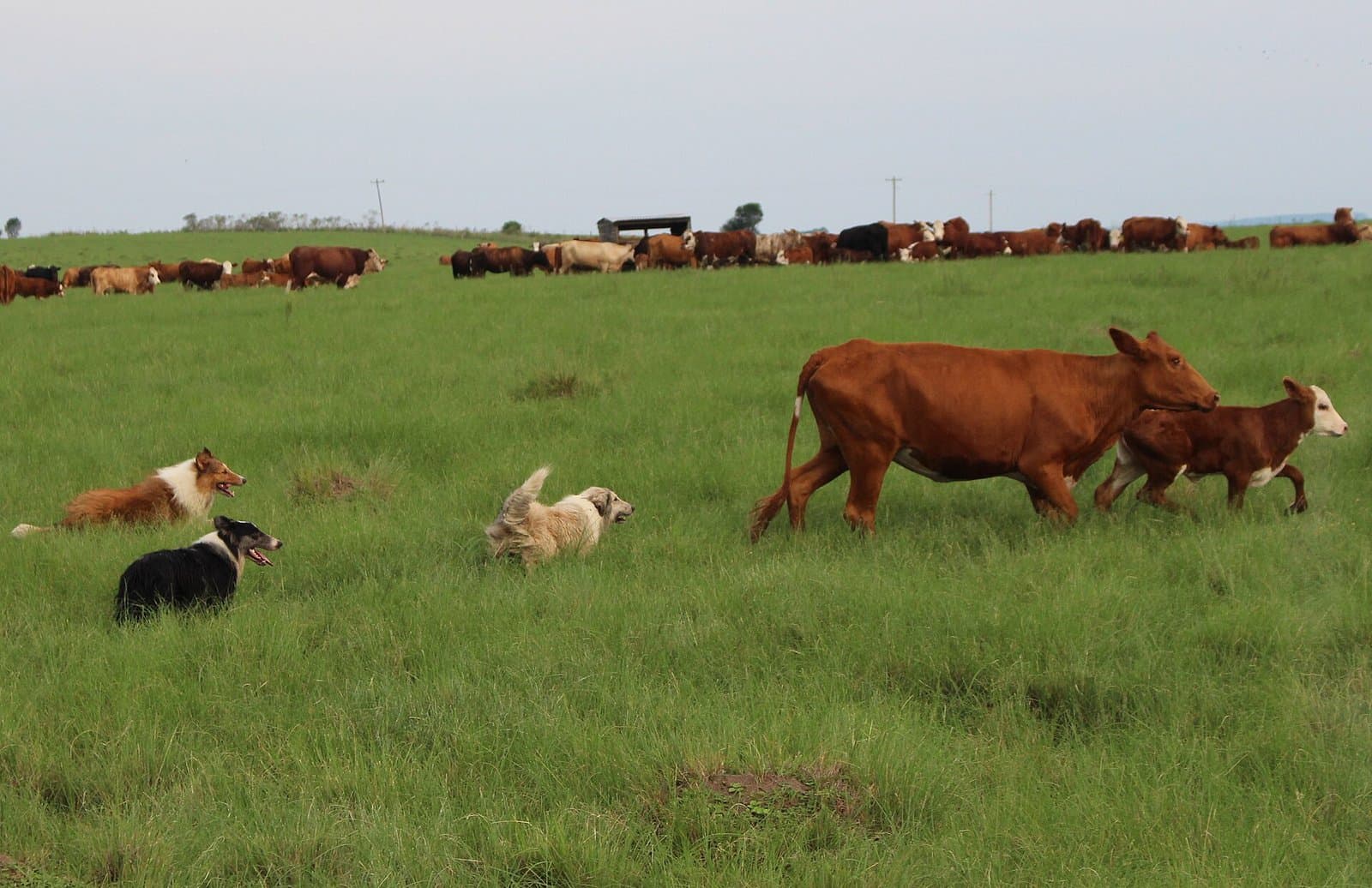
Which dog is right for a farm in Colombia?
The one that does what your farm needs and can handle its climate. Before thinking about breeds, answer three questions: whether you want the dog to work with animals, to let you know who is arriving or to keep the family company; how high above sea level the farm is; and how much time someone will spend with the dog each day.
| What you need | What that asks of the dog | What to look for |
|---|---|---|
| Moving cattle | Herding instinct, stamina, obedience at a distance | A herding dog, and someone who knows how to train it |
| A dog that raises the alarm | Attention to its surroundings and attachment to its people | A watchful, stable dog, not an aggressive one |
| Company on a weekend country property (finca) | Calm around visitors, children and other animals | A sociable dog that tolerates days with little going on |
Many farms ask for all three, and no dog delivers them unless someone teaches it. The breed supplies the inclination; the rest is handling.
Which herding dogs work on a farm in Colombia?
The two most familiar here are the Border Collie and the Australian Cattle Dog. Both belong to FCI (Fédération Cynologique Internationale) Group 1, sheepdogs and cattle dogs, but they were bred for different work: the first as a sheepdog, the second to gather and move cattle in open country.
The Border Collie standard defines the breed in one word, sheepdog, and describes its character as tenacious, hard-working and highly tractable; keen, alert, responsive and intelligent, neither nervous nor aggressive. It is one of the breeds the FCI classifies “with working trial”. In practice it is a dog that learns very fast and needs someone to teach it: we explain this on the Border Collie page.
The Australian Cattle Dog standard — the breed Colombians call pastor ganadero australiano or Blue Heeler — says it was developed for Australia’s young cattle industry, which needed a strong, biting dog with great stamina, able to gather and move wild cattle on unfenced properties. It adds something any farm owner will care about: its loyalty and protective instinct make it a guardian of the cattleman, his herd and his property, and it is naturally wary of strangers. Its temperament, the good and the difficult, is covered in the guide Blue Heeler: temperament, farm and family.
Is the Bernese Mountain Dog a good farm dog?
Yes, on the right farm. The Bernese Mountain Dog is, by origin, a farmers’ dog: its standard says it was used as a guard dog, cattle dog and draft dog on the farms of the canton of Bern, in Switzerland, and that today it is a family dog and a versatile working dog. Its limit in Colombia is the climate.
Standard No. 45 describes it as self-confident, attentive and watchful, affectionate and devoted to its own people and placid toward strangers. It is not a tireless driving dog like the other two: it is a large, calm companion that raises the alarm and keeps you company.
It is also a long-coated dog from the foothills of the Alps. On a farm in the cool highlands (tierra fría) it is in its element; in the hot lowlands (tierra caliente) it suffers, and that is not something it gets used to. The details are in the guide Bernese Mountain Dog in hot climates.
Which farm dog suits your climate and altitude?
In Colombia, altitude decides the climate, and that rules out breeds before any other criterion does. Of the three in this article, the Australian Cattle Dog tolerates heat most easily, the Border Collie sits in the middle and the Bernese Mountain Dog is a cool-highland dog.
| Breed | What its standard defines it for | Where it fits most comfortably |
|---|---|---|
| Australian Cattle Dog | Cattle dog: controlling and moving cattle | From the hot lowlands to the cool highlands |
| Border Collie | Sheepdog | Cool and temperate climates; in the hot lowlands, only with work during the cooler hours |
| Bernese Mountain Dog | Guarding, driving and draft work on farms | Cool highlands; in a temperate climate, with heat management |
In any climate, a working dog needs shade, clean water always within reach and rest during the sunniest hours: a herding dog does not stop on its own. To see how your municipality suits each breed, use the guide which dog suits your city’s climate.
What diseases do ticks transmit to a farm dog?
The one people know most is ehrlichiosis, caused by the bacterium Ehrlichia canis and transmitted by the brown dog tick, Rhipicephalus sanguineus. It ranges from an infection with no symptoms to a serious illness with lethargy, loss of appetite, weight loss and fever. The same tick can transmit other agents.
A study from the Universidad de Antioquia published in 2022 notes that these agents are common in veterinary practice in Colombia and little studied. The figures it gathers vary widely by population: 2.2% in shelter dogs in the southern Valle de Aburrá, 10.9% in a national study from 2016 and 18% among dogs with clinical signs in Medellín in 2020.
Prevention has three parts, according to the ectoparasite guideline from ESCCAP, the European council on companion animal parasites:
- Regular external parasite treatment. In warm climates ticks can feed all year round, so control is not seasonal. Your veterinarian decides what to use and how often.
- Check the dog. After work in pasture or scrub, run your hands over the ears, neck, armpits and between the toes.
- Remove them as soon as possible. With a tick-removal tool and gloves. The guideline says not to use oil, alcohol or ether.
What does a farm dog need besides space?
People, a job and boundaries. Space alone neither tires nor trains a dog: a herding dog loose on 10 hectares (25 acres), with nobody working with it, is no better off than in a backyard. What these breeds need is activity with a person, every day, and a safe place to stay.
- Fencing. A fence it cannot jump or get under, and gates that close. A dog with herding instinct that gets onto the road chases cars, motorcycles and other people’s cattle. What the law says about dogs off the property is in the Police Code and dogs.
- Shelter. A roof, a dry floor and real shade, not just an overhang.
- Daily company. If the farm is a weekend place and during the week only the farm manager (mayordomo) sees the dog, the dog is the manager’s: agree on that with him first.
- Introduction to the animals. Chickens, calves and horses are introduced while the dog is a puppy, on a leash and calmly.
- A veterinarian nearby. Find out in advance who handles emergencies in your rural district (vereda) and how far away they are.
When is a working dog on the farm a bad idea?
When there is no work and nobody to keep it company. A Border Collie or an Australian Cattle Dog on a weekend farm, with no cattle, no training and owners who show up two days a week, is a frustrated dog that herds whatever it finds: chickens, children or the cars on the road.
It is also a bad idea if the climate is not the dog’s own, if the farm cannot be fenced or if nobody in the household has had a demanding dog before. In those cases there are more suitable options than a herding breed, and adopting a calm adult dog is one of them.
Frequently asked questions
Which dog is right for a farm?
The one that fits what the farm needs and its climate. To move cattle, a herding dog such as the Border Collie or the Australian Cattle Dog; for a family farm in the cool highlands, the Bernese Mountain Dog can be a good fit. None of them works without time and handling.
Is a Border Collie good with livestock?
Yes. FCI Standard No. 297 defines it as a sheepdog and describes it as tenacious, hard-working and highly tractable. It needs training and daily work: without a job, it invents one.
Which dog copes with the heat on a farm in the hot lowlands?
Of the breeds on this site, the Australian Cattle Dog tolerates it most easily and the Bernese Mountain Dog least. Even so, any dog needs shade, clean water and rest during the hottest hours.
How do I protect a farm dog from ticks?
With a plan of external parasite treatments agreed with your veterinarian, frequent checks of the coat and immediate removal of any tick you find. Veterinary guidelines say not to use oil, alcohol or ether to remove them.
Can a farm dog live outdoors on its own?
It can sleep outdoors with proper shelter, but it cannot live without people. Herding dogs were bred to work alongside a person; isolated and with nothing to do, they develop behavior problems.
Sources
- FCI: Standard No. 297, Border Collie. Utilization and temperament. Spanish edition of the standard
- FCI: Standard No. 287, Australian Cattle Dog (Boyero Australiano). Utilization, brief historical summary and temperament. Spanish edition of the standard
- FCI: Standard No. 45, Bernese Mountain Dog (Boyero de Montaña Bernés). Utilization, brief historical summary and temperament. Spanish edition of the standard
- Revista Colombiana de Ciencias Pecuarias (Universidad de Antioquia), 2022: prevalence of Ehrlichia canis and Hepatozoon canis in shelter dogs in the southern Valle de Aburrá. Vector, clinical signs and figures from earlier Colombian studies
- ESCCAP, Guideline No. 3: control of ectoparasites in dogs and cats (Guía n.º 3: control de insectos y garrapatas que parasitan a perros y gatos). European guideline, adapted into Spanish in 2010: general principles of control. The local protocol is set by the veterinarian. In Spanish
Topics farm · herding · working dogs · ticks · climate
Keep reading
- Dog coat care by coat type: brushing, bathing and trimmingCare and daily life
- Genetic tests in dogs: what CEA, TNS, MDR1 and PRA are and how to read the resultHealth tests and pedigree
- Hip and elbow dysplasia in dogs: what it is, how it is evaluated and what each result meansHealth tests and pedigree
- All articles
Related guides and breeds
- Blue Heeler: temperament, farm and family (and what Bluey has to do with it)Guide
- Which dog suits your city’s climate in Colombia?Guide
- Can a Bernese Mountain Dog live in a hot climate? A city-by-city guide to ColombiaGuide
- Border Collie: the breed profile
- Australian Cattle Dog (Blue Heeler): the breed profile
- Bernese Mountain Dog: the breed profile
- All guides